




Kansas is located in one of the most wind-exposed regions of the United States. From straight-line thunderstorm winds to seasonal tornado events and winter storm systems, structural design in Kansas demands rigorous wind load analysis.
For civil engineers, developers, construction professionals, and policymakers, understanding wind load requirements in Kansas means aligning with the International Building Code, ASCE 7 provisions, and locally adopted standards while accounting for regional wind variability.
This guide provides a technical and actionable overview of Kansas wind load requirements, including design wind speeds, exposure categories, risk classifications, and structural best practices.
Kansas Wind Hazard Profile
Kansas consistently experiences high straight-line wind events due to severe thunderstorms and seasonal frontal systems. Portions of the state also fall within the broader Tornado Alley region.
According to the National Weather Service, Kansas records frequent severe wind events exceeding 60 mph gust thresholds during convective storm systems.
The NOAA Storm Events Database confirms recurring high wind events across central and western Kansas.
High Risk Safety Note: Severe thunderstorm winds and localized tornado events can exceed standard design wind speeds, particularly in western and central Kansas.
Governing Codes and State Adoption
Kansas building code adoption occurs at the local jurisdiction level. Most municipalities adopt:
International Building Code
International Residential Code
ASCE 7 Minimum Design Loads and Associated Criteria for Buildings and Other Structures
Compliance Risk: Engineers must confirm the specific edition of ASCE 7 adopted by the local authority having jurisdiction. Design values vary by edition.
ASCE 7 Wind Speed Maps for Kansas
Kansas design wind speeds are determined using ASCE 7 ultimate wind speed maps.
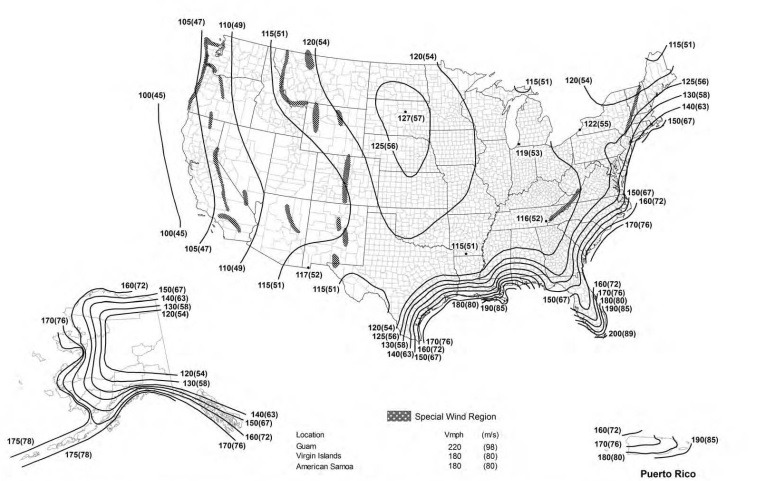

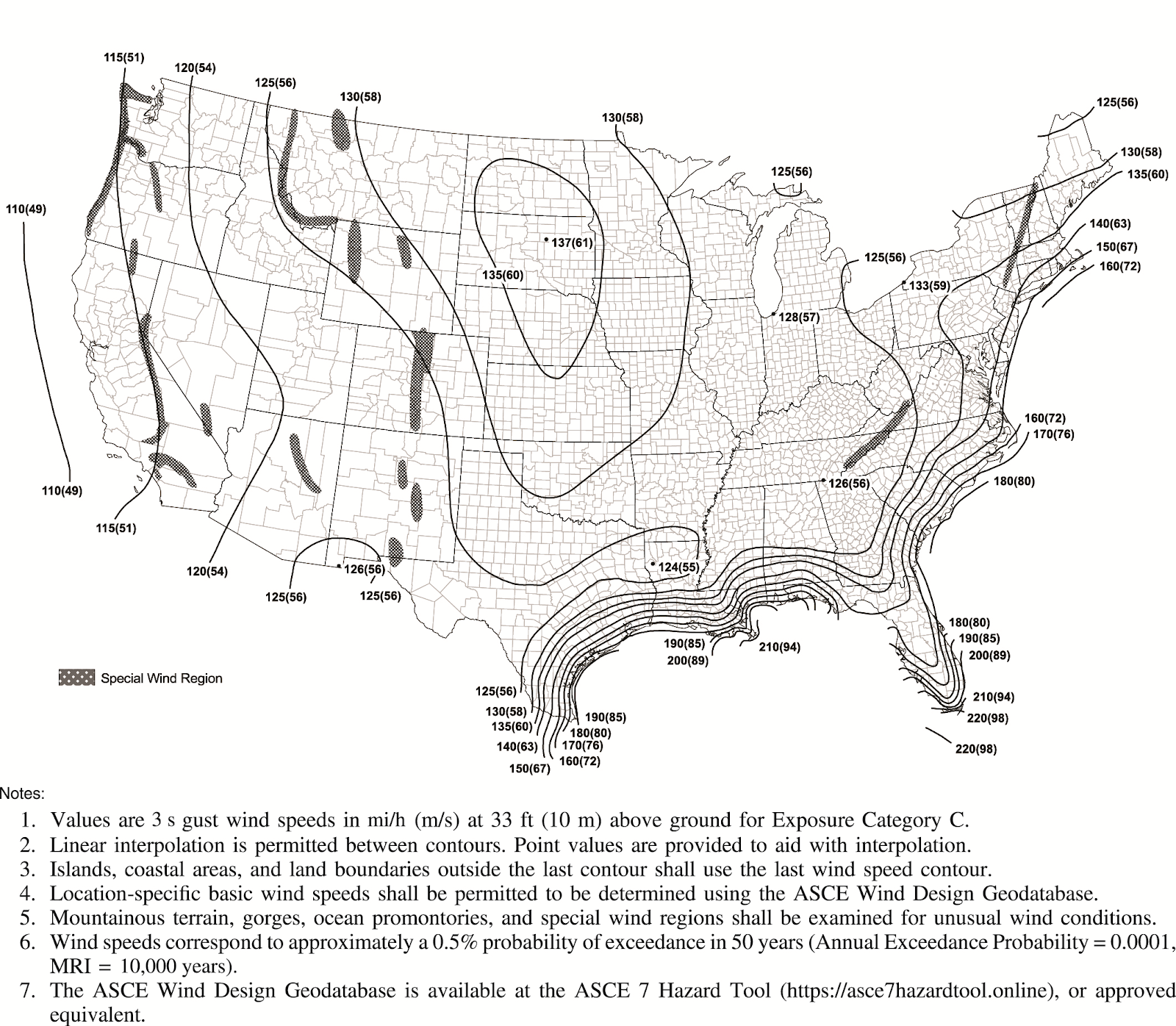
Typical ultimate wind speeds in Kansas range from:
- 115 mph in portions of eastern Kansas
- 120 to 130 mph in central regions
- Higher localized values depending on risk category
Wind speeds vary by:
- Risk category
- Geographic location
- Topography
Technical Note: Ultimate wind speeds must not be confused with nominal speeds used in older allowable stress design methods.
Risk Categories and Importance Factors
ASCE 7 classifies structures into four risk categories:
Risk Category I
Low hazard structures. These are not required to be designed for tornado loads.
Risk Category II
Standard residential and commercial buildings. These are not required to be designed for tornado loads.
Risk Category III
High occupant load structures
Risk Category IV
Essential facilities such as hospitals and emergency response centers
Higher risk categories require:
- Increased design wind speeds
- Higher importance factors
- Enhanced structural redundancy
Regulatory Risk: Misclassification of building occupancy can lead to underdesign and potential liability exposure.
Exposure Categories in Kansas
Exposure classification significantly influences wind pressure calculations.
Exposure B
Urban and suburban areas with obstructions
Exposure C
Open terrain with scattered obstructions
Exposure D
Flat unobstructed terrain exposed to large bodies of water
Much of rural Kansas falls under Exposure C due to open terrain conditions.
Engineering Risk: Underestimating exposure category can significantly reduce calculated wind pressures and compromise structural performance.
Internal Pressure and Enclosure Classification
Wind design must consider building enclosure classification:
- Enclosed
- Partially enclosed
- Open
Partially enclosed buildings experience higher internal pressure coefficients.
Common Kansas design issues include:
- Agricultural buildings with large door openings
- Warehouses with roll-up doors
- Metal buildings without adequate enclosure detailing
High Risk Condition: Improper enclosure classification can double uplift loads on roof systems.mpliance Issue: Storm shelters must meet ICC 500 standards and cannot rely solely on standard IBC wind provisions.
Components and Cladding Design
ASCE 7 requires separate evaluation of:
Main Wind Force Resisting System
Components and Cladding
Components and cladding pressures are often higher due to localized suction zones.
Critical elements include:
- Roof panels
- Edge flashing
- Doors and windows
- Metal wall panels
Failure of components and cladding frequently leads to progressive structural damage.
Roof Uplift and Connection Detailing
Roof uplift is often the governing wind load case in Kansas.
Engineering strategies include:
- Reduced fastener spacing
- Reinforced truss-to-wall connections
- Structural diaphragm continuity
- Edge zone reinforcement
Load combinations under ASCE 7 must evaluate:
- Wind uplift
- Combined gravity and wind
- Overturning forces
Financial Risk Warning: Retrofitting roof connections after construction is significantly more expensive than designing correctly at initial construction.
Tornado Considerations in Kansas
While standard building codes focus on straight-line wind loads, Kansas is also exposed to tornado events.
ASCE 7-16 and ASCE 7-22 include optional tornado load provisions for certain structures.
However, most residential and commercial buildings are not required to be designed for full tornado wind speeds unless designated as essential facilities or storm shelters.
Storm shelters must comply with:
ICC 500 Standard for the Design and Construction of Storm Shelters
High Risk Safety Note: Tornado wind speeds can exceed 200 mph, far beyond standard wind map values.
Common Engineering Mistakes
Incorrect exposure classification
Using outdated wind speed maps
Ignoring internal pressure amplification
Overlooking rooftop equipment anchorage
Underdesigning metal building systems
Metal building systems are widely used in Kansas for agricultural and commercial structures. These require careful connection detailing and diaphragm design.nificantly.
Actionable Compliance Strategy
Engineers working in Kansas should:
- Verify locally adopted IBC and ASCE 7 edition
- Confirm risk category classification
- Determine exposure category through site evaluation
- Evaluate enclosure condition carefully
- Calculate both MWFRS and C&C pressures
- Coordinate structural and geotechnical analysis
- Provide complete wind load documentation for permit review
Developers should consider voluntary enhanced wind resistance for critical facilities or high-value assets.
Frequently Asked Questions
What wind speed should I design for in Kansas
Design wind speed depends on location and risk category but typically ranges between 115 mph and 130 mph based on ASCE 7 ultimate wind speed maps.
Is tornado design required for standard buildings in Kansas
No. Standard buildings are designed for straight-line wind loads. Tornado design provisions apply primarily to storm shelters and certain essential facilities (Risk Category III and IV).
What exposure category is common in Kansas
Exposure C is common in rural and open terrain areas, while Exposure B applies in urban environments.
Does Kansas adopt ASCE 7-22 statewide
Adoption occurs at the local jurisdiction level. Engineers must confirm with the authority having jurisdiction.
Final Thoughts
Wind load requirements in Kansas reflect a combination of straight-line wind design, open terrain exposure conditions, and tornado risk considerations.
For engineers and developers, compliance requires precise classification of exposure, risk category, enclosure condition, and load path continuity.
In a state where wind is a persistent structural force, resilient design is both regulatory necessity and risk management strategy.
Design for durability. Engineer for safety. Partner with Gunderson Engineering for wind load analysis, structural calculations, and code-compliant solutions across Kansas.